Essential Spices in an Indian Kitchen

Spices are so integral to Indian cooking. They have the ability to completely transform a basic dish and give it that authentic touch. However, Indian cooking is also quite vast and a dish may or may not use many spices. And for a beginner, that might seem a bit confusing or overwhelming.

Indian food appeals to the entire globe but my non-Indian friends and colleagues keep mentioning how they cannot wrap their heads around the spices and the techniques of the cuisine. Indian cooking might also seem very intimidating for a beginner who loves to eat Indian food but does not necessarily know how to make it. While there is actually nothing that can be called as “Indian food,” some of the spices are common across all states. Each state in India does represent a mini country in itself, with their own disctict culinary heritage. It will not be possible to share each and every state’s spice mix, but the generic ones are pretty much the same everywhere.

So if you are a beginner and want to set up your pantry specifically for Indian cooking, you have landed at the right page. I have been cooking and eating Indian food and here is my two cents on essential spices in an Indian kitchen. This list is strictly on the basis of my personal knowledge and understanding of Indian spices. If you think I have missed out on anything, please let me know.

Ground Spices

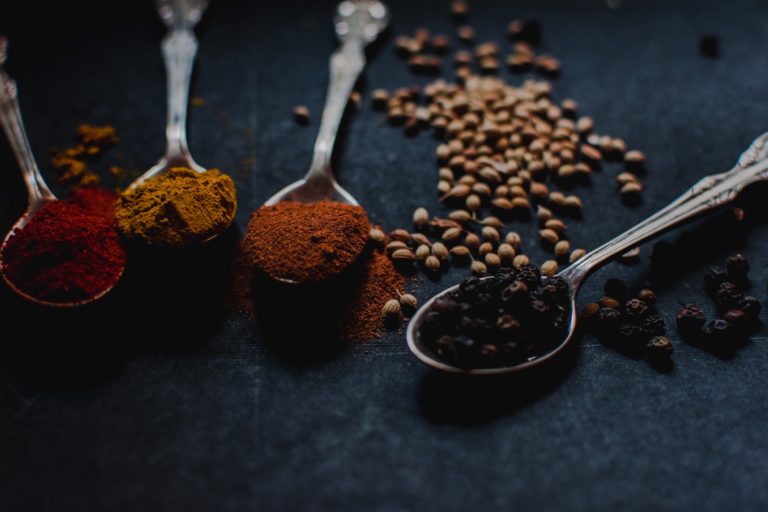
1. Cumin powder – Jeera

I honestly have to think really hard if I have to name any Indian curry dish that does not have cumin in it. Cumin or jeera is an essential spice that Indians add to almost all of their “regular” dishes. If you’re thinking dals, curries, pulaos, biryanis or korma – cumin has to be there! So get hold of some cumin powder. And the fresher the better! I suggest you buy cumin seeds, dry roast them and grind them to a fine powder. The fragrance of fresh cumin powder is unmatched.

2. Turmeric powder – Haldi

Turmeric powder again is one of the key ingredients in Indian food. The yellow colour in any curry or gravy comes from turmeric, especially in all kinds of dal preparations. You can either get turmeric powder or also invest in raw turmeric. The benefits of adding turmeric in our diets has even been cited in Ayurveda. Turmeric contains several bioactive compounds that have powderful medicinal properties. Curcumin is the compound in it that is anti inflammatory, boosts immunity and protects the body against several diseases.

3. Coriander powder – Dhania

Coriander powder or dhaniya is another essential Indian spice which is used in all major curry preparations. Again, it’s best to buy the seeds, dry roast them and blend them to a powder than buy readymade coriander powder from the store. Croainder powder adds a lot of flavour to Indian preparations, and can also be used as a garnish to fresh chutneys and dips.

4. Black pepper powder – Kali mirch

Black pepper is also used in Indian cooking. While it may not be as common as thespices listed above, it is still a popular spice in Indian kitchens. I for one cannot deal with the absence of black pepper powder in my kitchen. I like to make my own black pepper powder by grinding black pepper seeds. Or just crush some seeds just in between cooking to add to my meals.

5. Red chili powder – Lal mirch

Indian food has the reputation of being extremely hot. While that might be the case for certain cuisines, it’s not a generic truth. The level of heat varies from region to region, and also as per personal preference. In my house for example, I never saw red chili powder in the pantry. We always used fresh or dried chillies as opposed to powder. But that’s not the case everywhere. But having said that, keeping some red chili powder is essential.

There are two kinds of red chili powder that goes into Indian cooking – deggi mirchi and Kashmiri mirchi. Deggi mirchi is the one which is actually hot. Kashmiri mirchi is not very hot but adds a beautiful red colour to dishes. It is used in tempering and also marination. You can keep a little of both as per your preference. Personally, I am a huge fan of Kashmiri chili powder.

6. Garam masala

Garam masala is a mixture of different whole spices that is usually added right at the end of the cooking process. It adds a beautiful flavour and warmth to dishes. The combination of garam masala spices varies from region to region. I come from the eastern part of India where our garam masala is a simple mix of cardamom, clove and cinnamon. But the spice mix can be a lot more than this simple ingredients. You can make your own garam masala or buy one from a really good brand.

7. Dried fenugreek – Kasuri methi

Dried fenugreek leaves or kasuri methi is a show stopper for many meals. It has an amazing flavour of its own that has the ability to change the game for a dish altogether. It is a garnish you must have in your kitchen and it makes way for amazing curries, dals, parathas or even subzis.

8. Dry mango powder – Amchur

Dry mango powder or amchur is used a lot in north Indian cooking. It adds a tang to curries and other preparations. It’s a personal favorite and I always keep some handy. It is also a great addition to koftas and parathas.

9. Cardamom powder – Elaichi

Green cardamom is used as a whole spice as well as in its powder form. It is an expensive spice as compared to the rest because of its superior flavour. The seeds are powdered to get a smooth powder that is added in many gravies as well as several Indian desserts. You can make it at home for best fragrance and flavour. Or you can buy it from a good brand.

10. Asafoetida – Hing

Asafoetida has a strong and pungent aroma that adds a beautiful flavour to curries and stews when tempered in oil.

Whole Spices

Here is a list of all the whole spices that go into making different Indian delicacies. It is used in tempering and garnishing in various dishes.

1. Green Cardamom – Elaichi

Whole green cardamoms are crushed and used to flavour many Indian dishes like pulao, biryanis, korma, curries, desserts and even for chai or tea.

2. Black Cardamom – Badi Elaichi

Black cardamoms have a tough skin and are mainly used as a part of garam masala to flavour savory dishes like curries, pilafs, stews or dals. They can also be used to flavour broths. It is vastly different from the green cardamom in terms of texture, aroma or flavour.

3. Cloves – Laung

Cloves are used for tempering dishes as well as to make tea. It has a refreshing aroma and is also used as a medicine for dental ailments.

4. Cinnamon – Dalchini

Cinnamon can be used for tempering as well as for flavouring some sweet dishes.

5. Cumin seeds – Jeera

Cumin seeds are used extensively as a tempering element in various Indian dishes. It’s always a good idea to keep some cumin seeds handy.

6. Nigella seeds – Kalonji

Mostly used in Eastern cooking (Benagli and Assamese) to flavour their briths and curries, kalonji is one of my favorite whole spices. It’s aroma is very subtle but unique. It is used to flavour pickles, added to curries and stews, added to paratha and puri doughs and also added as a garnish.

7. Fennel seeds – Saunf

Fennel seeds are used in pickles and also in curries and for tempering. It has several medicinal properties and adds a distinct flavour to dishes.

9. Carrom seeds – Ajwain

Carrom seeds are not cooked in oil, but added to doughs, pickles and also eaten as it is as a cure to digesive issues. I love adding them to my parathas!

10. Mace – Javitri

Another flavoring spice mostly added to biryanis and rich gravies. Mace has a distinct flavour and requires just a little usage at a time.

11. Mustard seeds – Rai

Mustard seeds are very common in Indian cooking as used as a tempering agent. It is added to curries, broths and is used to flavour chutneys and pickles too.

12. Saffron – Kesar

One of the most expensive spices in the world, the wonders of saffron are many. It is used in savory as well as sweet dishes. If you are making biryani or a royal phirni/kheer, saffron is a must.

13. Nutmeg – Jaiphal

Nutmeg has a very distinct and pungent flavour and fragrace. It is used to add warmth to several Indian curries and sweet dishes. The dried seeds will last in your kitchen forever.

This is obviously not the end of it all. There will be many more local varieties in different states. Indian food also uses a lot of condiments. This is my list as far as spices are concerned.

I hope this helps you and you find it easier to set up your pantry for Indian cooking. If you have any doubts, please reach out to me in comments or my social media handles.

Find me on Instagram – www.instagram.com/slurrpilicious

Find me on Facebook – www.facebook.com/slurrpilicious

Find me on Youtube – https://www.youtube.com/channel/UCA-cJoo27OLSCswI4sy6lzA?

Happy cooking!

How It All Began – Inspiration Behind the Love for Cooking

I close my eyes to focus more on the situation. I am in the kitchen, not more than three feet tall, watching my father take over the entire space. I watch as he dices the onions and the tomatoes on a beautiful Sunday afternoon, washes the rice, soaks them gently in lukewarm water, and freshly grinds all the coarse spices. I can see from his face that he is really enjoying himself. The house is filled with a familiar scent — a delicate mix of spices and herbs. These are the traces of the start of the inspiration for cooking.

This was the smell that emanated from the house every Sunday afternoon, the smell of pure happiness, the sweet scent of childhood. Even though I was little, I used to love to see my father cook. Every Sunday, he would make an authentic Assamese chicken or mutton curry, along with some amazing pulao, with cashew nuts, raisins, and clarified butter.

My mother, on the other hand, used to be done with the rest of the cooking quite early in the morning. I liked my father more because he would start late and take all his time to prepare the much anticipated weekend lunch, a source of tremendous inspiration to me. As simple as his preparation would be, it would never fail to be absolutely delectable. Even though those times weren’t so abusively divided between weekdays and weekends, I used to look forward to Sundays because of my father’s meals. Almost as much as me and my brother used to look forward to the sweets that our father used to get us whenever he would be home after a business trip (In those days, flying used to be a big deal and airlines used to be very generous with free stuff).

As the cooking process would start, so would my curiosity of witnessing the assimilation of spices. I would be too curious to understand how he is tossing up the vegetables in the kadhai or how long it actually takes for the fried onions to change its color. Since I was too short, I recall my father solving this problem of my unending inquisitiveness by lifting me up and making me stand on murha (a stool made of woven cane, found in north-east India), so that I could observe it LIVE. And I used to take everything in, while he explained the process to me, step by step. I used to do this every Sunday with him, almost like a ritual and for the longest time, till I didn’t need the murha anymore.

A lot of people might argue here as to why am I not saying the same for my mother. Society had made even the seven-year-old me believe that mothers are meant to be in the kitchen. As a child, I would never look forward to the meals cooked by my mother, as they were too ordinary (only now do I realize how delicious and healthy her cooking is, and the reason why I am still alive and have a functional immune system).

I also think it was unique to see my father cook and spend so much time in the kitchen, as it is supposed to be a woman’s job otherwise, something we take for granted. None of my friends ever boasted about their father’s recipes, so it was different for me, a nice different. Most people would laugh about how their fathers don’t even possess the skill to boil an egg or make a cup of tea. I felt proud that my father was self-sufficient that way, even as a child. I was my father’s biggest fan when it came to recipes. And this rage continues till today. Only that now we learn from one another.

Childhood experiences like these have made me realize that I am a simpleton at heart. As much as we might try and assimilate into the city and our work life madness, some of us still enjoy the simplest of things, like a steaming cup of gingered tea on a rainy afternoon, or the simple need of listening to a song with a loved one, or just being comfortably silent and enjoying the moment. I believe when it comes to innovating, simplicity is the hardest to crack. I am trying to do this with my recipes as well. And I want to keep focusing on producing simple recipes using seasonal ingredients, which are as equally relished and craved for, as would a five-star meal.

I am known amongst my friend and family circle as a “domestic” being, someone who would keep her husband very happy. I know it all comes down to being able to feed the husband. Though most of them aren’t serious, it definitely comes across as a big quality to have from an “arranged marriage” perspective. But the fact remains that I love to cook, and I also prefer cooking healthy. Not that I do not have the qualities of a modern woman. In fact, I think I am very empowered in a country like India as I get to decide a lot of things for myself. Having lived alone in a city for so many years, I have now mastered a lot of my own recipes, pampered my friends with food from time to time, and also cooked for myself on days I have felt low. Too bad I don’t have pictures of the weekends in the 90’s. But frankly, I don’t need a physical photograph, as the mental images are still quite clear.

It is from my own roots that I have learned the value of homegrown and seasonal produce. Whenever I go home, I see how our previous generations are so well versed in what to eat, how to prepare traditional meals, and stay healthy as a result. Being able to grow your own organic produce and consume it on a daily basis is perhaps one of the biggest joys and blessings of life. As I am growing older, I am understanding this more and more. It has also made me question the availability of spinach in monsoons, or why people do not eat seasonally but prefer what the West seems to be loving, such as the recent avocado craze. Do we really need it in India?

Food and culture are so entwined. I am trying to start from my own roots, and I have realized how little I know of my own Assamese food. I make it a point to visit home as often as I can, talk to my aunts and uncles who grow their own food. And who do you think accompanies me during such trips? My father of course! 🙂

Cooking for people gives me joy beyond words. It is in fact, my meditative therapy.

I connect the most with people who like to cook and understand food like I do. My best friends are people who love to cook for themselves and their loved ones. I respect people who can fix themselves and their friends with a snack or a meal. Whenever people eat my food, they comment on how lovely it is and how they couldn’t stop themselves from gobbling it all up, feeling almost guilty. Another source of monumental inspiration! And I can’t help but smile.

So I have started. Started my own tiny space in this big web of information, sharing what I know and learning from the community.

The internet does give a lot of motivation to do something on your own, and so do a lot of people around you. I am not quitting my job or taking any rash decision here, but I am just trying to balance my love for cooking with my daily, mundane life, which I also enjoy. It is a simple thing and a not-so-simple effort. But since I am loving it so much, I shall continue. To me, this is just the beginning.

What’s your story of self-discovery?